

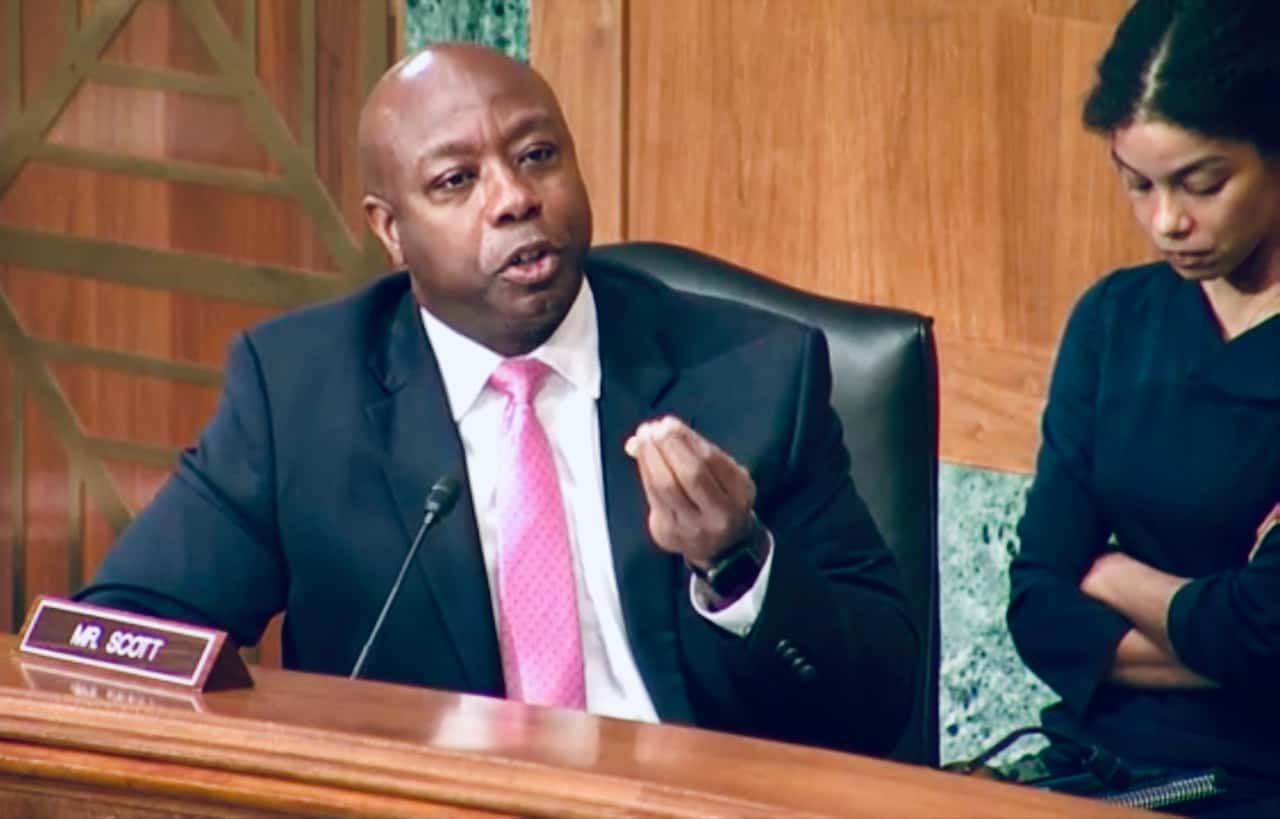
Last week, Senate Banking Committee Chairman Tim Scott commented on President Donald Trump’s support for the GENIUS Act (S. 1582), legislation that aims to establish a federal regulatory perimeter to facilitate stablecoin innovation. More specifically, payment stablecoins issued by private firms tied to fiat currency. The bill was approved by the Senate in a vote last week, with 68 Senators voting for the bill and 30 against. Only two Republicans voted against the bill, which garnered solid bipartisan support. The bill is now awaiting action in the House.
Scott stated:
“President Trump is right – the time to lead is now. The GENIUS Act will establish clear guardrails for innovation, protect consumers, bolster national security, and ensure the next chapter of the digital economy is written right here in the United States. I encourage the House to act quickly and send this bill to President Trump’s desk.”
Writing in the Washington Examiner, Scott noted that at its core, the legislation is a consumer protection bill. He pointed out that stablecoins are already in use but without federal oversight.
“The GENIUS Act brings digital assets and payment stablecoins out of the regulatory gray area and into an anti-money laundering compliance regime. It imposes important requirements on stablecoin issuers — the same ones banks and other financial institutions already follow — that strengthen national security and improve the Treasury Department’s ability to monitor the sector. Passing this bill will make it harder for bad guys, whether foreign or domestic, to use stablecoins to fund illicit activity.”
Senator Scott shared a post by President Trump encouraging Congress to finish the job.
— Tim Scott (@votetimscott) June 19, 2025
This past Tuesday, Senator Scott was joined by Senators Cynthia Lummis, Thom Tillis, and Bill Hagerty to release a set of principles for the development of comprehensive market structure legislation. The Crypto Market Structure Principles are expected to set a baseline for negotiations on the language of the bill.
These principles state:
- Legislation Should Clearly Define the Legal Status of Digital Assets
- Jurisdiction Should Be Clearly Allocated Among Regulators
- Regulation Should be Modernized to Foster Innovation
- Regulation Should Protect Those Who Purchase or Trade Digital Assets
- Illicit Finance Measures Should Be Targeted and Pro-Innovation
- Federal Financial Regulators Should Welcome Responsible Innovation
The complete outline of the principles is available here.
Former SEC Division of Enforcement Branch Chief Steve Gannon, who is now a partner at Davis Wright Tremaine, shared a comment with CI stating that the US may finally be on the cusp of a coherent regulatory regime, but the path is not straightforward.
 Gannon said the Crypto Market Structure Principles are all laudable but there will be varying degress of difficulty in securing passage.
“Defining regulatory boundaries between agencies should be reasonably straightforward. Ensuring that investors are protected during bankruptcy proceedings will be a popular measure. The SEC’s Crypto Task Force is already paving the way for fundraising and registration issues and is clearly differentiating between centralized and decentralized crypto projects,” stated Gannon. “On the other hand, defining the details with respect to preventing money laundering and sanctions evasion is likely to be challenging, as is ensuring consistency from federal banking regulators regarding which crypto-related activities are permissible.”
Regardless, the effort will be worth it, added Gannon, as regulatory frameworks outside the US are advancing quickly and digital asset markets have already struggled domestically with extensive delays.
“American foot-dragging will likely be penalized in the marketplace,” cautioned Gannon.

