


When I stood on stage at TOKEN2049 in Singapore this month, I shared what was still only a seed of an idea: adapting the blockchain I helped build to withstand quantum computers. A week later, our community opened a vote on researching the move, and backed it with 93.5% support across more than 2,800 wallets. We did not vote. The community made the decision alone.
The attack is already underway. No machine has yet made public blockchains insecure, but a cryptographically relevant quantum computer (CRQC) capable of breaking public-key cryptography is likely near, as insiders tighten timeframes. Some anticipate the quantum paradigm will be breached by the mid-2030s; others are more optimistic, expecting a few more years.
Blockchains don’t contemplate changes this drastic on a hunch. That reaction tells us something the financial world has yet to absorb: people care about the quantum threat, and they are looking for someone to act on it.
Ethereum is targeting 2029 to become quantum-safe. In my view, that is too late, and deadlines slip, as anyone who waited years for the Merge, Ethereum’s long-delayed overhaul of how it secures its network, will remember.
While some say Q-Day, the moment a quantum computer can break today’s encryption, is decades away and overhyped. My community has decided not to wait and find out. The rest of the financial world should take note, because the reason is the same for everyone.
The timeline to Q-Day is getting shorter. AI is advancing at remarkable speed, and the financial world still believes the threat to its data is a speck on the horizon. It is much closer than that, and AI is accelerating it.
In January, the G7 Cyber Expert Group identified 2035 as a broad target for migrating the financial sector to quantum-resistant cryptography. Google and Cloudflare are both working towards 2029, six years earlier, to complete their own post-quantum security migrations. Neither predicts Q-Day will arrive by then. But Cloudflare points to Google’s improved quantum algorithm for attacking elliptic-curve cryptography, and reads Google’s priorities as a sign that it is preparing for Q-Day as early as 2030.
Breaking today’s encryption with a quantum computer requires progress on three fronts: more qubits, better error correction, and algorithm optimization.
AI is helping on all three fronts. For example, Google DeepMind’s AlphaQubit uses AI to identify errors inside a quantum processor more accurately than conventional methods. AI is also helping scale up the number of qubits and find smarter algorithms that could mean a quantum computer needs fewer qubits and less computing time to break today’s encryption.
One striking example is ECDSA.fail, a research challenge focused on a key calculation in the quantum algorithm that could eventually break the cryptography protecting Bitcoin and Ethereum. More than 100 researchers and AI agents, including our own, spent two months making that calculation more efficient and cut its benchmark resource score (logical qubits required multiplied by the number of operations) by 86.1%.
Quantum computers still can’t crack Bitcoin, and the capability isn’t here, or likely in the next couple of years; the pressure is mounting.
Researchers are getting closer to the quantum-computing methods and architectures needed to attack, for example, Bitcoin’s elliptic-curve cryptography. Research by Oratomic explicitly analyses how such a machine could break cryptography, and its researchers acknowledge that capability could threaten Bitcoin and other systems. They say a neutral-atom quantum computer with as few as 10,000 physical qubits might eventually be capable of such an attack, provided error correction and other major engineering challenges can be overcome.
Together, these advances may be shrinking the gap from both ends, making quantum computers more capable while reducing the resources needed to attack encryption.
The consequences extend well beyond cryptocurrency. Attackers are already practicing “harvest now, decrypt later“, collecting encrypted data with a long shelf-life today and storing it until quantum computers become powerful enough to read it. That means information that must stay confidential for years: financial records, government communications, medical data, intellectual property and commercial secrets. Data stolen today could become readable in the future, even if the encryption protecting it is considered secure now.
Banks, Fintech platforms, technology companies and financial networks must prepare by identifying vulnerable systems and migrating to quantum-resistant cryptography. Blockchains face an additional challenge. Quantum computers could eventually undermine the digital signatures used to authorize transactions, putting cryptocurrency assets at risk.
Knowing that quantum computers could eventually break today’s cryptography is only the start. The harder task is building a blockchain that can withstand that threat and adapt as cryptographic methods evolve, for example by swapping in new signature schemes without a hard fork. That is the work Starknet has now begun.
Nobody can predict exactly when Q-Day will arrive. The wider digital economy must prepare for it, and blockchain networks must do likewise. We no longer need binoculars to see that speck on the horizon.
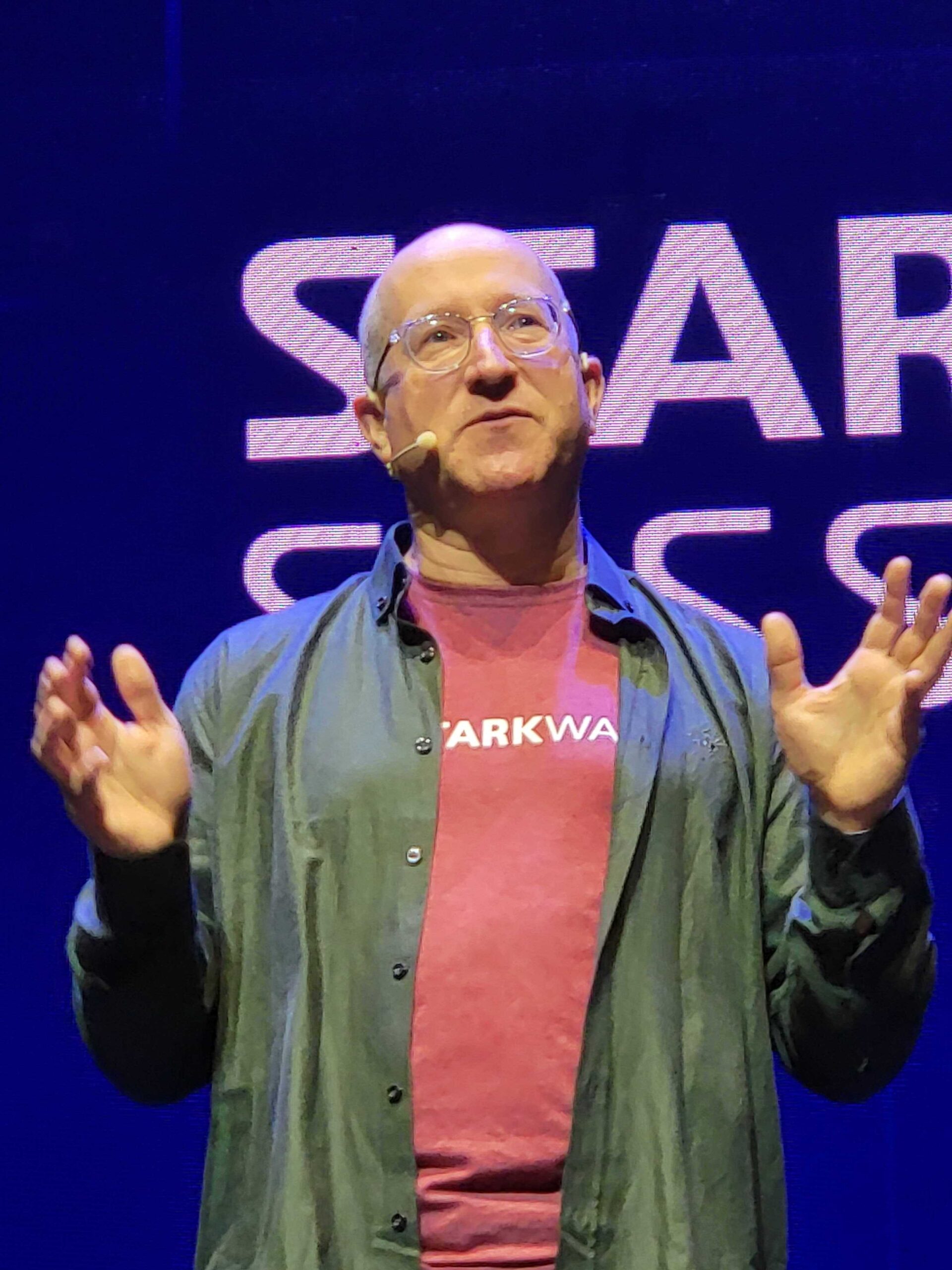
Eli Ben-Sasson is a cryptography pioneer who protects privacy and prepares financial systems for the threat of quantum computing. He co-invented STARKs, the technology behind Starknet and StarkWare, the $8 billion company he co-founded and leads as CEO. He was also a founding scientist of the privacy cryptocurrency Zcash. He is the author of the USA Today bestseller Zero Knowledge, Infinite Trust (Wiley, 2026), a beginner’s guide to crypto.

