

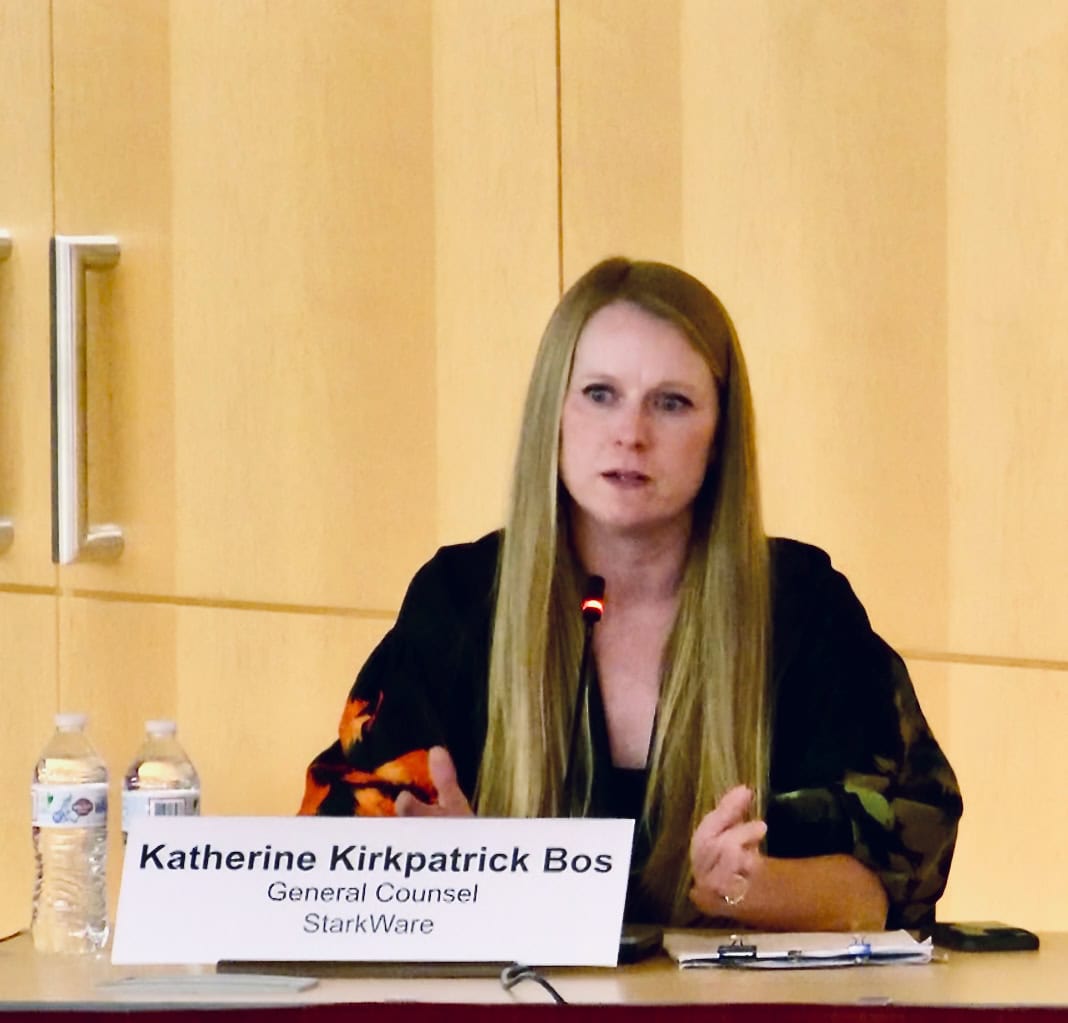
This week, Katherine Kirkpatrick Bos, General Counsel of StarkWare, participated in the Securities and Exchange Commission’s Crypto Task Force Roundtable addressing privacy and financial surveillance. This is a hot topic today, especially with the advent of blockchain-powered financial services. While many blockchains allow anyone to view transactions, there is a push to safeguard identifiable information about these activities. Additionally, the federal government has a poor track record of respecting the privacy of the populace, and interest in privacy creates an opportunity to update rules and requirements impacting financial services and personal information.
StarkWare is a company that enables the use of zero-knowledge proofs. This technology allows counterparties to obtain verifiable information without disclosing unnecessary details. Users can safeguard private information while participating in digital transactions with confidence. StarkWare offers ZK-STARK tools and platforms (StarkEx, Starknet) to support blockchain scaling and privacy. Their services may be the solution we need to address privacy concerns while streamlining validations and financial services.
In opening remarks at the Roundtable, Commissioner Hester Peirce, head of the Crypto Task Force, stated:
“Our national degradation of financial privacy and the rules that embody it are overdue for a change, and crypto is helping to nudge a reassessment. On the one hand, crypto opens new possibilities for transactions without the financial intermediaries that are central to existing financial surveillance programs. Tokenized securities transactions, for example, can occur without the intermediation of a broker. As our personal transactions become increasingly disintermediated, government will receive less information about those transactions from traditional channels. On the other hand, the public blockchains on which many crypto transactions take place are viewable by everyone, which creates a demand for privacy-protecting tools. Accordingly, as crypto usage increases, the public and relevant government agencies need to rethink when and how financial transactions are surveilled.”
During the Roundtable, Kirkpatrick Bos noted that Americans should not have to provide personally identifiable information for every transaction and should be able to use tools to protect themselves without being suspected. Currently, many people default to “ease of use” over privacy, even though privacy should be a fundamental right.
Regarding identity verification, Kirkpatrick Bos stated that current AML and KYC practices are increasingly outdated in an age of generative AI.
“When you ask someone to send a photocopy of their driver’s license, we’ve reached a point of absurdity. With AI, fake documents can be generated in seconds. Manual processes don’t make sense anymore, there must be a better way.”
Privacy-oriented cryptographic systems could offer stronger, more reliable verification than today’s document-based checks.
Recently, CI connected with Kirkpatrick Bos to learn more about StarkWare and the company’s goals. Kirkpatrick Bos has worked with many top firms, including the CBOE. We asked her why she decided to join StarkWare. She said that working with brilliant people is educational and invigorating.
“StarkWare is filled with best-in-class cryptographers, technologists, engineers, and developers. We are also best in class in zero knowledge proof technology. I knew I would learn something and also add value to StarkWare’s legal and regulatory strategy.”
StarkWare holds a mission to create the “Integrity Web,” which aims to let users control their data. We asked Kirkpatrick Bos at what stage of development this project is. She stated that cryptography-based solutions can be used to protect private data and restore control over data to individuals. StarkWare is “hard at work building technology that furthers the Integrity Web mission – and our technology is the best fit for privacy.”
So why are ZK-STARKs better than alternatives? And are they truly quantum proof?
“ZK-STARKs are resistant to quantum proof computing threats, because they have a number of technical features that make them secure and more resilient (for example, transparent setup, scalable proof construction). StarkWare’s CEO, Eli Ben-Sasson, has been researching cryptographic and zero-knowledge proofs for more than 20 years, so STARKs are truly at the forefront of this technology and best placed to assess the quantum landscape.”
Currently, Starkware is primarily working with Ethereum and Bitcoin, so what about other protocols?
“StarkWare understands that a lot of crypto companies lose focus when they try to do too many things at once. StarkWare has long been associated with Ethereum and expanded its focus to Bitcoin about a year ago, because we believe in expanding the Bitcoin economy and helping to bring more utility to Bitcoin,” shared Kirkpatrick Bos. “StarkWare is also a big supporter of OP_CAT, a proposed Bitcoin upgrade aiming to bring Ethereum-like smart contract capability to Bitcoin.”
So, why the emphasis on Bitcoin? And what about this soft fork? Kirkpatrick Bos said Bitcoin has seen more institutional engagement than any other crypto asset. Beyond that, StarkWare has invested heavily in expanding Bitcoin’s functionality and supporting the burgeoning Bitcoin economy.
“Privacy is a key missing piece in building that real Bitcoin economy (or any economy), so we are also working on that piece.”
We inquired about what StarkWare is currently doing in the finance/Fintech sectors. Who are you working with? Is it mostly about identity? Asset integrity?
“StarkWare is primarily a software developer and data-compression services provider, and it is a major developer of Starknet – the Ethereum and Bitcoin Layer 2 or L2″. On Starknet, there are now a number of applications that provide ways for users to make their Bitcoin more productive. Starknet also provides the ability for institutions to use Appchains, which are essentially customizable Ls that inherit the security of the layer they settle on. Appchains are akin to private blockchains in that entities with a lower appetite for risk can customize settings and access,” explained Kirkpatrick Bos.
 As the market infrastructure bill (The CLARITY Act) is in the works, we asked if she was optimistic that the legislation would help enable DeFi and foster an effective ecosystem for digital asset development. As many digital asset insiders have been working with policymakers, we inquired whether she has been engaged with advocates on the bill’s language.
“Yes – policy work and legislative and regulatory engagement are absolutely key right now, because a lot is in flux. Further, it is essential that crypto market participants work collaboratively with legislators and regulators to provide essential education about how the technology works. One of the biggest questions surrounding CLARITY is how it will deal with DeFi, as there is a lack of alignment between the House and Senate, and Democrats and Republicans,” she said. “Many crypto stakeholders hope that legislators understand the need to protect developers of decentralized systems from liability.”
Regarding regulators and the potential for “Suptech” by StarkWare, Kirkpatrick Bos noted that they are not a regulated entity, so they have not formally engaged with regulators. Still, they are working with the Blockchain Association and other policy organizations to ensure that pending legislation is not detrimental to our strategy or broader users or developers in the crypto ecosystem.
Kirkpatrick Bos believes that the market is ready and Americans need these tools. What is missing is a regulatory framework that recognizes that better technology exists.

