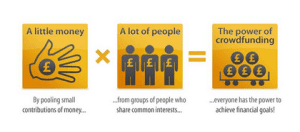
 CrowdCube, the UK based Equity Crowdfunding platform, has initiated a partnership with Constellation Capital. Constellation Capital describes themselves as:
Constellation Capital is a London based advisory firm specialising in early stage technology companies across a wide range of sectors. We provide services ranging from business strategy and commercialisation through to funding raising and investment.
In a posting on the CrowdCube site Constellation CEO, Stuart Hillston stated;
“Crowdcube is setting the pace with its innovative crowdfunding model, which solves an aged-old problem for many businesses. We looking forward to working with Crowdcube to fund businesses that we work with.”
As part of the partnership with Constellation, Hillston has shared some salient advice for potential crowdfunders. These suggestions are a derivative of years of reviewing business plans. Hilston’s a summary of his first five recommendations on the hunt for funding are listed here:
1 “The numbers are conservative”
Nine out of ten CEO’s/entrepreneurs will tell you that their plan is conservative, that they could do much better than this and believe they will. So why give conservative numbers? It is intended to convey the potential for far greater things – that the numbers will deliver a decent return but the potential is far greater.
Investors tend to take the view that your sales will be slower & lower, and that your costs will be inexorably higher.
2 The entire product brochure/manual with long lists of bulleted features
Seriously, do you honestly think I’m going to read this? The product is interesting and relevant, but an investor invests in a business. So what they really need to know is how you will sell your product – who to, how, how much, when. Too many business plans are padded out to ridiculous lengths (I got one last week at 147 pages – breaks two of the “rules” here).
3 “Exit is a trade sale or float”
Everyone says this so how can you differentiate yourself? In fact you can pretty much cut & paste the words between all the plans without changing them (which begs the question – why are they there?)
So what should you say?
Well if you think you are really going to float, be specific about which market, why and how. If you’ve been following AIM recently you will know that there have been a lot of overseas natural resources companies, and a lot of technology de-listings (companies that should probably not have been floated in the first place). So you will have to make a very good case for why you will buck a current trend, how you justify the cost of the flotation (and maintaining the listing afterwards), and how you will ensure that shareholders can get an exit without destroying your share price.
4 “We only need 0.0001% of the global market to be profitable”
It is a common sight to see a market described as some huge number (whether in value or number of customers) and then by a process of extrapolation, a profitable business appears from a very small percentage of the market. However, your business plan is a guess of what will happen, and will be wrong – just about every business plan is “out”. The number you provide is an average of the likely outcomes, so it stands to reason that the range of outcomes will vary wildly. And as most business plans tend to overestimate the rate and value of sales, and underestimate the rate and value of costs, it stands to reason that the most likely outcome will be 0%!
5 Your 6 page CV
This is another standard way of padding out a business plan to make it too big to read. If it is necessary, include management
CVs in the Appendices – but keep them short. The main thing is to describe the relevant experience of each member of the team in the body of the plan and include CVs simply to provide the background should someone which to see the background.
Better yet, complete your LinkedIn profile to 100%, get some recommendations, and simply point anyone interested to the relevant LinkedIn profiles – save a tree!
The Complete list of recommendations may be found here.