

Last month, the Securities and Exchange Commission (SEC), Office of the Inspector General (OIG), issued a memo stating there were “avoidable errors” that led to the loss of former SEC Chairman Gary Gensler’s texts.
On January 17, 2024, the SEC Office of Information Technology (OIT) reported that earlier in the year, the SEC erased “nearly a year’s worth of text messages sent and received” by Gensler.
The memo states that an effort was made to recover deleted messages, but the attempt failed.
The OIG has issued five recommendations for corrective actions to prevent the recurrence of public information deletions at the SEC. The SEC stated last August that it is also reaffirming its policy that prohibits agency officials from conducting business on personal devices.
Although there is no comment on intentional activity, it appears that Coinbase, once the target of an SEC enforcement action, is not entirely convinced. In a post on X, Coinbase Chief Legal Officer Paul Grewal states that a court hearing is scheduled to take place next week to “address the destruction of documents by the Gensler.”
Republicans on the House Financial Services Committee sent a letter to SEC Chairman Paul Atkins expressing “serious concerns” about these events that occurred during Gensler’s tenure at the SEC.
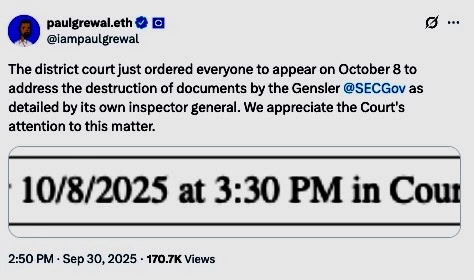 In another post on X shared yesterday, Grewal reported that the SEC is currently unable to engage due to the government shutdown.
There is a touch of irony here as the SEC strictly requires financial services firms to save communications in case of allegations of illicit activity. The agency penalized multiple firms for the same type of activity during the past few years.
The SEC penalized more than 100 financial services firms for these types of violations during Gensler’s term. Large firms, such as JPMorgan and Goldman Sachs, paid significant fines to the SEC.
Among others, on September 27, 2022, the SEC touted that 16 Wall Street firms agreed to pay $1.1 billion in penalties for “longstanding failures by the firms and their employees to maintain and preserve electronic communications.”
There is also an appearance of convenience due to Gensler’s controversial leadership of the Commission, which was mired in obtuse rulemaking and politicking.
While there have been no claims of nefarious activity, it will be interesting to see if anything emerges from the court’s inquiry.